
News
- Home
- News
PostProcess Expands Automated Post-Processing Offerings with new DEMI X 520™ Resin Removal Removal Solutions
Buffalo, NY, US and Mougins, France, February 1, 2024 — PostProcess Technologies, a pioneer in automated post-processing solutions for additive manufacturing (AM), announced today the launch of two revolutionary solutions in their lineup of automated, intelligent post-processing solutions: DEMI X 520 for Resin Removal™ and DEMI X 520 for Dental Resin Removal™. These offerings extend the PostProcess Submersed Vortex Cavitation™ portfolio by introducing our new patent pending Axial Flow Technology™, delivering unparalleled efficiency, sustainability, and ease of use.
Combining intelligent software capabilities, robust hardware features, and specially formulated chemistry, these solutions achieve optimal IPA-Free resin removal on 3D printed parts. New features help to deliver a simple, personalized and complete full-stack post-processing experience.
Key benefits of our complete solution include:
- Software-Driven Workflow Automation: intuitive user-guided experiences catered to each application create seamless, efficient, and error-free operation.
- Axial Flow Agitation System: With the capability to adjust flow, this system optimizes performance while reducing the risk of part damage, ensuring safe and optimal processes and part outcomes.
- Automatic Lift System: Fully automating process workflows, both DEMI X 520 solutions feature an automatic lift to streamline operations and control part exposure, minimizing the need for operator intervention.
- IPA-Free Workflow with Patented Chemistry: PLM-403-SUB provides a biocompatible, environmentally-friendly workflow and a safer alternative for cleaning and rinsing parts. When combined with a rinse in our AUX-400-RINSE chemistry, it can eliminate the need for IPA in post-processing.
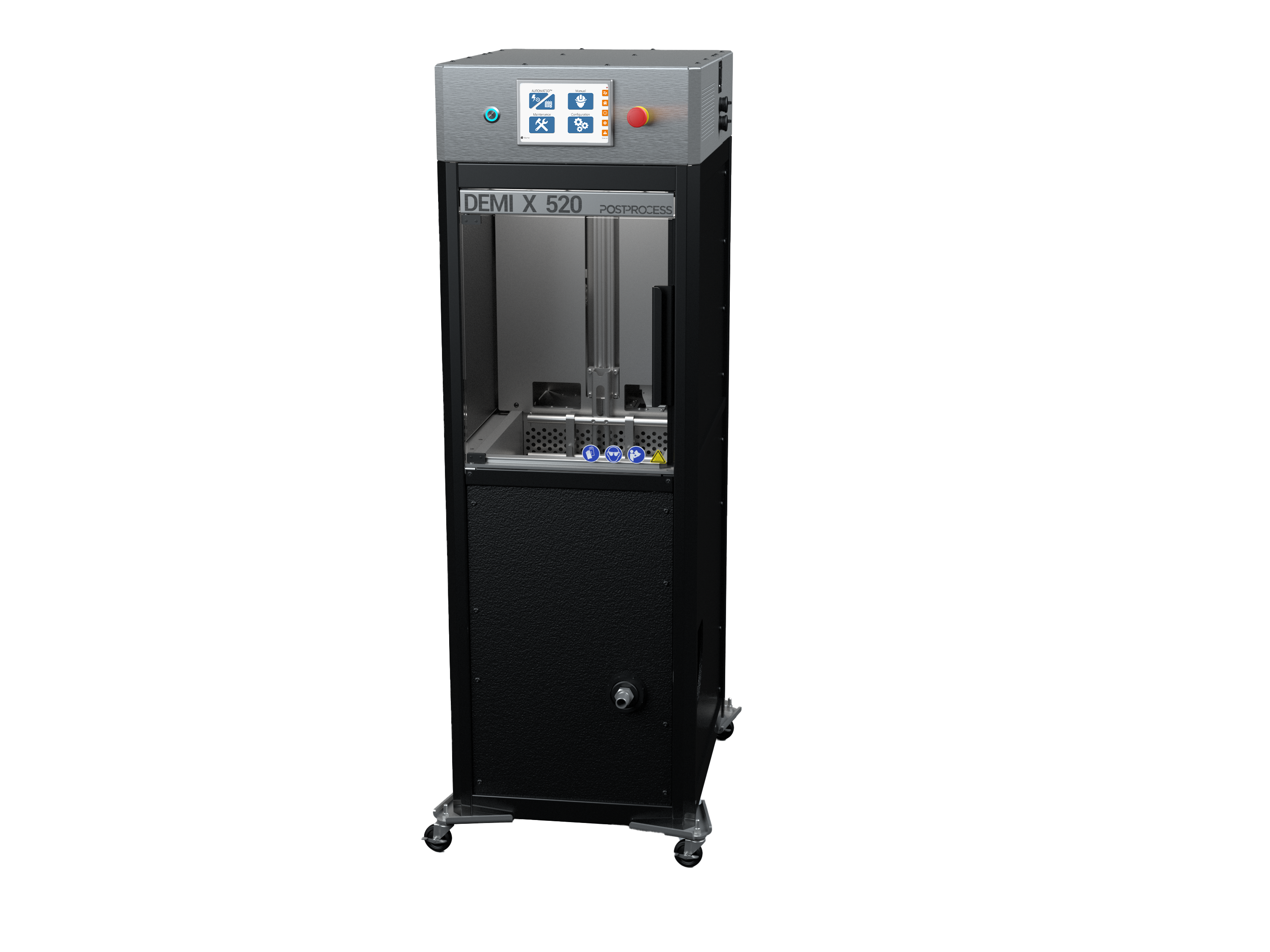
Both solutions in the DEMI X 520 series deliver enhanced safety and efficiency. Engineered for operator well-being, they feature a chemistry that produces low odors and offer high flashpoints compared to traditional solvents like IPA. Our intelligent solutions ensure unparalleled consistency through validated workflows, enabling high-quality, repeatable cycles. This innovation translates into increased throughput and productivity, setting a new standard for precision and reliability in resin removal technology.
Long standing industry experts Great Lakes Dental Technologies, located in Buffalo, NY, have experienced firsthand how the next generation of IPA-Free resin removal has improved their dental post-processing.
“For over 50 years, employee-owned Great Lakes Dental Technologies has dedicated itself to providing best-in-class appliances with unparalleled precision and quality through the adoption of cutting-edge technology,” says Sean McPhail, Team Lead from Great Lakes Dental Technologies. “The integration of PostProcess’s advanced automated dental resin post-processing solution has allowed Great Lakes to improve process efficiencies, saving valuable time and resources. PostProcess’s innovative expertise has enabled Great Lakes to improve and consistently meet and exceed customers’ expectations for excellence.”
“With a deep commitment to cutting-edge innovation, we continue to redefine the landscape of additive manufacturing by providing advanced solutions that optimize workflows and deliver exceptional quality and sustainability for a range of industries.” states Jeff Mize, PostProcess CEO. “Our DEMI X 520 Series represents our dedication to pushing the boundaries of what’s possible in the world of post-processing.”
Interested in learning more about the DEMI X 520 for Industrial Resin Removal? Register for our webinar on Thursday, February 8 2024 at 10am EST to get a live lab demonstration with the DEMI X 520 and be part of the exclusive Q&A session. Register here:
If you’re interested in our DEMI X 520 for Dental Resin Removal solution, register for our webinar with Great Lakes Dental Technologies happening on Thursday, February 13th at 10AM:
Post Process Technologies – Webinar: How it works, Automated polyjet post-processing
Sign up today for a PostProcess webinar and demo of automated 3D post-processing focused on polyjet support removal. Conducted by one of our engineering experts broadcasting from our lab, you will get a close-up view of how software, hardware, and chemistry work together for transformative end part results. See the solutions running on the proprietary AUTOMAT3D® platform and engage in real-time Q&A.
Εκδήλωση 3DENT 9.6.2023, «Τρισδιάστατη εκτύπωση για την παραγωγή εξατομικευμένων κατασκευών στην οδοντιατρική»
Η κοινοπραξία του Ερευνητικού έργου 3DENT, με συντονιστή φορέα την ΕΒΕΤΑΜ Α.Ε., οργάνωσε εκδήλωση διάχυσης των αποτελεσμάτων του έργου με θέμα:
«Τρισδιάστατη εκτύπωση για την παραγωγή εξατομικευμένων κατασκευών στην οδοντιατρική». Η εκδήλωση πραγματοποιήθηκε με φυσική παρουσία, στις εγκαταστάσεις του ΕΜΠ την Παρασκευή 09 Ιουνίου 2023.
Το έργο «3DENT-Τρισδιάστατη εκτύπωση για την παραγωγή εξατομικευμένων κατασκευών στην οδοντιατρική», υλοποιείται στο πλαίσιο της Δράσης Εθνικής Εμβέλειας “ΕΡΕΥΝΩ – ΔΗΜΙΟΥΡΓΩ – ΚΑΙΝΟΤΟΜΩ” της Παρέμβασης ΙΙ (Β’ κύκλος)– Συμπράξεις Επιχειρήσεων με Ερευνητικούς Οργανισμούς, η οποία συγχρηματοδοτείται από εθνικούς πόρους (μέσω του Ε.Π. Ανταγωνιστικότητα, Επιχειρηματικότητα & Καινοτομία – ΕΠΑνΕΚ, ΕΣΠΑ 2014-2020) και από κοινοτικούς πόρους (Ευρωπαϊκή Ένωση, Ευρωπαϊκό Ταμείο Περιφερειακής Ανάπτυξης) (κωδικός έργου Τ2ΕΔΚ-04124).
Το συνεργατικό σχήμα του έργου αποτελείται από έναν ερευνητικό φορέα, το Εργαστήριο Μεταλλουργίας της Σχολής Μηχ. Μεταλλείων Μετ/γων του ΕΜΠ, έναν επιχειρηματικό τεχνολογικό φορέα δημοσίου συμφέροντος, την ΕΒΕΤΑΜ Α.Ε., που δραστηριοποιείται στην Εφαρμοσμένη Έρευνα, Τεχνολογική Ανάπτυξη, Πιστοποίηση & Ποιοτικό Έλεγχο ευρέος φάσματος υλικών και βιομηχανικών προϊόντων, και δύο μικρομεσαίες επιχειρήσεις, την εταιρεία LINO 3D που προσφέρει υπηρεσίες 3D εκτύπωσης και την εταιρεία NOVAMIND που δραστηριοποιείται στον χώρο των οδοντιατρικών/οδοντοτεχνικών υλικών και εμφυτευμάτων με 3D εκτύπωση.
Το έργο 3DΕΝΤ καθοδηγούμενο από τις ανάγκες της αγοράς για γρήγορη κατασκευή, εξατομικευμένων, ποιοτικών & υψηλής ακρίβειας οδοντικών αποκαταστάσεων, στοχεύει σε μια νέα προσέγγιση για την ανάπτυξη τους, βασισμένη σε προσθετικές μεθόδους παραγωγής, μελετώντας και συνδυάζοντας 2 κατηγορίες υλικών: μέταλλα- κεραμικά. Στο έργο αναπτύσσονται και μελετώνται με την τεχνική 3D-εκτύπωσης ολοκεραμικές αποκαταστάσεις με βάση τη ζιρκονία και μεταλλοκεραμικές αποκαταστάσεις με μεταλλικό σκελετό κράματος Co-Cr και επικάλυψη οδοντιατρικής πορσελάνης.
Την εκδήλωση χαιρέτησαν δύο προσκεκλημένοι ομιλητές παρουσιάζοντας τις εξελίξεις στον χώρο των οδοντιατρικών υλικών και στον χώρο της προσθετικής κατασκευής. Ο Ομ. Καθηγητής της Οδοντιατρικής σχολής ΕΚΠΑ κος Τριαντάφυλλος Παπαδόπουλος παρουσίασε τις εξελίξεις στο πεδίο των Υλικών και τις προκλήσεις στις οδοντιατρικές κατασκευές. Ο Δρ. Βασίλειος Δρακόπουλος, Διευθυντής Εφαρμογών του ΙΤΕ/ΙΕΧΜΗ και Επιστημονικός υπεύθυνος της ΕΚΕΠΕΚ ΑΕ, του Ελληνικού Κέντρου Προσθετικής Κατασκευής, παρουσίασε τις υπηρεσίες και την καθοριστική συμβολή της ΕΚΕΠΕΚ στην ανάπτυξη νέων τεχνολογιών στην οδοντιατρική και γενικότερα στον τομέα της υγείας.
Εκπρόσωποι των φορέων της κοινοπραξίας παρουσίασαν στην συνέχεια την επιτυχή ανάπτυξη καινοτόμων κεραμικών υλικών για χρήση στις μηχανές εκτύπωσης για οδοντικές αποκαταστάσεις, ενώ επισημάνθηκαν οι δυνατότητες χρήσης τους και σε πολλές άλλες εφαρμογές. Η επιτυχής κλιμάκωση παραγωγής νανοκόνεων ζιρκονίας και διαφόρων υλικών τροφοδοσίας σε μορφή inks/pastes για χρήση στις μηχανές εκτύπωσης από την EBETAM, ανοίγει επίσης νέες προοπτικές στο πεδίο της τρισδιάστατης εκτύπωσης προηγμένων υλικών στην χώρα.
Στο έργο αναδείχθηκε τόσο η δυνατότητα παραγωγής με 3D εκτύπωση υψηλής ποιότητας υλικών για ολοκεραμικές και μεταλλοκεραμικές οδοντικές αποκαταστάσεις, καλύπτοντας τα οδοντιατρικά πρότυπα ελέγχου ποιότητας, όσο και η δυνατότητα της τεχνολογίας για προσφορά εξατομικευμένων λύσεων.
Η Δρ. Κων/να-Ντία Ανδρεούλη, Διευθύντρια Έρευνας & Ανάπτυξης της ΕΒΕΤΑΜ και επιστημονική υπεύθυνη του έργου, επισήμανε την κρισιμότητα της αξιοποίησης των ιδιαίτερα σημαντικών αποτελεσμάτων του έργου από όλους τους φορείς και των ευκαιριών που παρουσιάζονται από το δίκτυο των στρατηγικών συνεργατών των επιχειρήσεων.
Την εκδήλωση παρακολούθησαν μηχανικοί, επιστήμονες υλικών, οδοντίατροι, τεχνολόγοι εκτύπωσης και εκπρόσωπος του φορέα χρηματοδότησης, Υπουργείο Ανάπτυξης και Επενδύσεων-ΕΥΔΕ-ΕΚ.
Mobile 3D scanning of Museum Artefacts
Museums collect valuable artefacts of human history. Its is a window to the past. A large amount of statues, sculpture and and other historical objects present what is long gone. The preservation of the past and reverse engineering processes become possible with 3D scanning technology. Get insights into a scan of a historical statue here.
The goal: a precise scan for the replica of the statue Nike
The War Museum in Greece is the largest museum of military history in the country and one of the largest in Southeastern Europe. It collects relicts of Greek history from all wartime periods. In honor of approx. 1600 Philhellenes who offered their services and often even their lives for the liberation of Greece, a monument is planned at the war museum.
For the Monument of Philhellenes the corrected statue of the well-known Nike (Goddess of Victory) needs to be replicated. The replica will be embossed in the center of the monument (Fig. 1).
For this project, a 3D scan of the original statue is created in this application example. The data collected will later be used to produce the marble duplicate using a CNC cutting machine.
The challenge of scanning
The challenge of the application is the creation of an exact scan and later duplicate of the statue.
The work here is complicated at first by the application environment. The confined space as well as the mounting of the statue on the wall makes scan data collection tricky.
With measurements of 1,2 m by 0,60 m the statue is a fairly large object to scan. Besides that, the original is characterized by the numerous details which should be maintained as best as possible. In order to achieve a realistic replica of the statue all details need to be collected accurately and reliably.
Both requirements have to be taken into consideration when scanning the Victory of Goddess.
The scan data must be as exact as possible since the statue is cut out of a marble block using a CNC marble cutting machine.
The digitized statue was the missing puzzle piece for the following replication.
In order to scan as fast and precise as possible, GOM Scan 1 was used. Due to the fringe projection (stereo camera approach) and the blue light technology, the 3D scanner provides detailed and accurate meshes.
The light weight and compact shape of the GOM Scan 1 turned out to be particularly suitable for confined spaces of a museum. The measuring volume furthermore allowed the collection of fine and small details as well as the digitization of the medium-sized part.
Lino Integrated Printing Solutions executed this task. As a long-standing partner in our network, Lino is experienced in the use of 3D scan technology. Based on years long experience, they chose the GOM Scan 1.
Michalis Bratsolias from Lino Integrated Printing Solutions reported that using the fringe projection technology, it was even possible to scan the whole statue almost without reference points.
The scanner operates with the GOM Inspect software. It was extensively used to digitize the statue. Step-by-step it guided the user through the scanning process. Thus, an accurate measuring was possible due to the constant reassurance of the software.
In the museal application, the sensor and GOM Inspect software were simply the perfect duo:
One stop solution to scan, edit, repair and even more.
Michalis Bratsolias
Ready for some behind the scenes footage of the application and the final result of the replica? Keep scrolling to see the GOM Scan 1 in action!
Thank you to Lino Integrated Printing Solutions for sharing the interesting application example, showing the divers uses of the GOM Scan 1.
PostProcess and EOS Announce Strategic Partnership to Enable More Sustainable Automation Through the Additive Manufacturing Workflow
BUFFALO, NY, USA – October 27, 2022 – PostProcess, the leader in automated and intelligent post-processing solutions for 3D printed parts, and EOS, a leading supplier for responsible manufacturing solutions via industrial 3D printing technology, announce a distribution partnership to provide a fully automated and sustainable depowdering solution for EOS customers. Complementing the EOS printer product range, the PostProcess Variable Acoustic Displacement™ (VAD) technology automates gross depowdering for 3D printed parts. This partnership makes it easier for customers to procure post-printing solutions, further enabling end-to-end digitization of the workflow from the part design through 3D printing to post-processing.
Existing methods of powder removal are highly manual or semi-automated and can cause in some cases safety and sustainability issues. This new solution by PostProcess using VAD is thermodynamically controlled with video and infrared monitoring while releasing, transferring, and recovering loose powder particles, hands-free.
The patent-pending VAD technology leverages software intelligence to optimize mechanical energy and intelligent closed-loop thermal and displacement techniques for revolutionary bulk depowdering results, enabling full process chain automation. The powder removal and recovery achieved with VAD technology improves process performance and control, providing customers with enhanced sustainability and employee safety, repeatability and productivity, and lower operating costs. Customers can print highly detailed and complex parts without worrying about breakage in the post-processing step.
“We are proud to solidify this partnership with EOS, a global leader in industrial 3D printing, to help end users more easily adopt the complete workflow of additive manufacturing and scale their operations,” stated Jeff Mize, PostProcess CEO. “EOS stands behind their sustainability objectives and shares in our dedication to ensuring additive manufacturing scales sustainably.”
Speaking to the collaboration Nikolai Zaepernick, Chief Business Officer at EOS, said, “This partnership with PostProcess provides a digital connection that enables traceability and connectivity. We found the perfect match with PostProcess in providing our customers with sustainable automated post-processing for their delicate and complex parts manufactured using the EOS P 500.”
Since it was first introduced in 2020, and as part of the validation process, VAD technology has been operating successfully with large industrial customers, processing hundreds of SLS cakes and thousands of parts in production environments. With its broader commercial launch at the end of this year, a few spots remain available for customers to participate in its Early Access Program. For more information, or to register for this limited VAD program, contact your EOS or PostProcess representative and learn more.
About EOS:
EOS provides responsible manufacturing solutions via industrial 3D printing technology to manufacturers around the world. Connecting high quality production efficiency with its pioneering innovation and sustainable practices, the independent company formed in 1989 will shape the future of manufacturing. Powered by its platform-driven digital value network of machines and a holistic portfolio of services, materials and processes, EOS is deeply committed to fulfilling its customers’ needs and acting responsibly for our planet. www.eos.info.
About PostProcess Technologies:
PostProcess is the leader in automated and intelligent post-printing solutions for 3D printed and additive manufactured parts. Founded in 2014 and headquartered in Buffalo, NY, USA, with international operations in Mougins, France, PostProcess removes the bottleneck in the final stage of the 3D printing workflow, post-processing, through a combination of patent-pending software, hardware, and chemistry technologies. The company’s solutions automate industrial 3D printing’s most common post-printing processes including support, resin, and powder removal, as well as surface finishing, enabling customer-ready 3D printed parts at scale and complete digitization of additive manufacturing through the workflow for the Industry 4.0 factory floor. The PostProcess portfolio has been proven across all major industrial 3D printing technologies and is in use daily in every imaginable manufacturing sector.
Please do read the official press release here.
3D Printing Can Be Used to Fight Against Bacteria
Due to the continuing COVID-19 pandemic, more than ever we are aware of how harmful and easily transmissible bacteria and other microbes are on surfaces. The mats that adhere there, some of which are slimy, are called biofilms and are often resistant to conventional disinfectants. They form complex communities and can even lead to life-threatening bacterial infections. But to eliminate this problem, a team of researchers at Montana State University in the U.S. has brought additive manufacturing into play to advance biofilm bacteria research using 3D printing technology. The goal here is to be able to produce a kind of tool that helps replicate the microbes. Researchers Zimlich and Thornton, who work at MSU’s Center for Biofilm Technology, have been working on the 3D printing device for two years.
Many tests and modifications later, however, they finally achieved their first success: the research object, which consists of a grid of individual bacteria inserted in hydrogel – a transparent, pudding-like substance – that they can precisely lay out at will, could be a great help for future bacterial transmissions. That’s because, specifically, it allows cells to be arranged and encapsulated exactly where they are needed to help fight bacteria. More specifically, the process involves imaging the microbes in the hydrogel and then solidifying the material with a laser to create an imperfect biofilm. While only one type of bacteria has been used so far in the research, if Zimlich and Thornton were to use other strains of bacteria, they could create more complex biofilms as a result.
A Forest Full of Bacteria
Comparable to a forest due to the sheer diversity of lifeforms present, Zimlich admits that even the simplest biofilm systems are complex species. For this reason, they felt it was their responsibility to combat microbes that may even be resistant to antibiotics. This is the case, he said, because the cells at the lowest level of the biofilm present are encapsulated from oxygen and enter a dormant state, making drugs ineffective against them. According to Phil Stewart, also a researcher at MSU, this phenomenon is explained by the fact that the bacteria have already undergone so many biological changes that such drugs are partially ineffective. Further development of such drugs is therefore inevitable, so that all forms of bacteria in the biofilm are attacked. However, Zimlich is optimistic and describes his idea for combating such a situation with bacteria, commenting, “One thing that’s becoming clearer is that there’s potential to treat these pathogenic bacteria by altering the interactive biofilm environment instead of trying to use harsh chemical products.”
But in order to further develop such treatments, numerous tests must take place in a controlled environment such as a laboratory. And that’s when the 3D printing tool finds its way. “We think it’s possible to construct analogs of how these pathogenic biofilms form naturally,” affirms Zimlich. With some 30 collaborative partners, the MSU research team also indicates in their press release that their research could even be of great interest to companies such as Procter and Gamble, 3M and NASA. More information on the project can be found HERE.
source: 3d natives.com
Why Combine 3D Printing and Industrial Automation Applications?
3D printing is widely used in the field of automation such as in compression molding. It’s a formative manufacturing method, currently popular in industry, that involves compressing the desired amount of molding material between two heated presses to give it its final shape. It is cost-effective compared to other production processes, allowing both small parts and large components to be designed. In addition, the base mold can be 3D printed, giving manufacturers more flexibility and geometric freedom. That’s why one electrical manufacturer has invested in several 3D printers from Flashforge, including 11 Creator 4 models. With this investment, the company was able to reduce its labor costs by 80% and cut delivery times by 50%.
Flashforge is a Chinese manufacturer that entered the 3D printing market in 2012. Since then, it has offered a wide range of solutions worldwide and caters to applications in education, healthcare, jewelry, and more. Among its wide range of 3D printers is the Creator 4, an industrial FDM machine with two independent extruders and different extrusion options to expand the range of compatible materials. It’s a ideal solution for multiples industries such as automotive, medical or consumer goods. It boasts a printing volume of 400mm*350mm*500mm, a heating plate capable of reaching 130°C and a closed chamber that can rise to 65°C. It is a solution that offers optimal temperature control combined with production flexibility, allowing it to be combined with automation processes, such as compression molding.
Integrating 3D Printing into the Compression Molding Process
One of the challenges of compression molding is the design of the hoppers and mold: each hopper must match the mold cavity exactly so that the material can flow properly. However, the molds used are not all the same shape, with different or irregular cavities, which multiplies the number of hoppers needed. Flashforge’s customer, which specializes in the manufacture of electrical equipment, explained: “Each project involves dozens, if not hundreds, of different shaped molds. Each size requires over a hundred hoppers. So, a completed project represents tens of thousands of hoppers. In the past, we have had to hire trade experts or even outsource the order. However, whichever solution we chose, it was costly in time and money, as was post-project maintenance.”
That’s where 3D printing comes in: the company relied on Flashforge’s Creator 4 machines to design the hoppers, freeing itself from the various shape, labor, time, and maintenance constraints of the past. As a result, the company invested in 11 machines and is now able to complete the design and production of 40 hoppers in a single day, about 10 more than before, all with only one employee on the job.
The 3D printer is capable of creating the hoppers with an accuracy of 0.2 mm to meet the necessary requirements. In addition, the Creator 4 is compatible with a wide range of materials, allowing the company to produce stronger, more abrasion-resistant molds and hoppers. The company uses ABS, nylon, polycarbonate and other technical materials to increase the durability of parts.
Benefits of Flashforge’s 3D Printing Solutions
In addition to this material compatibility, Flashforge 3D printers also allow teams to better control the manufacturing process and ensure that parts meet compression molding requirements. The resulting hoppers are lighter and easier to replace in the event of a defect.
Finally, the company estimates that it saved 10% of its labor costs in the first year and increased its output by 35%. A representative concluded: “Our customer orders are increasing and we will have to increase our production rate. Thanks to 3D printing, we can organize ourselves quickly and meet these growing needs. This is a real plus for us because we are able to meet demand in a flexible way.” If you have any 3D printing needs in terms of automation processes, feel free to contact Flashforge’s team HERE.
WEBINAR: Revolutionizing Jewelry Making with 3D Printing
Since the start of civilization, jewelry has been an important part of the lives of humans worldwide. From the prehistoric era to ancient civilizations to our modern era, it has always been one of the key items created in societies as it allows us to display status, decorate our bodies and, of course, has a sentimental connection. And indeed, it cannot be denied that the industry is still growing strong, with the global market expected to reach $255.42B USD by 2027. But just because a tradition is ancient, does not mean it cannot be improved upon. 3D printing, especially DLP and binder jetting, is increasingly being adopted by the jewelry industry thanks to its ability to quickly and more cheaply create intricate, detailed designs.
In our next webinar, “Revolutionizing Jewelry Making with 3D Printing,” come learn about how both resin and metal 3D printing are already being used to revolutionize the jewelry sector. We will be joined by experts from Lino and Kranias Astroroes Jewelry, a family owned jewelry business in Thessaloniki who was on the forefront of 3D printing adoption for jewelry manufacturing in Greece, on July 12th at 4PM CEST/10AM EDT/5PM EEST as they explain how 3D printing compares to traditional manufacturing in the sector. Furthermore, they will explain in detail the benefits of using 3D printing for jewelry making as well as the differences in using resins and metals and the specific advantages of both. The session will be followed by a live Q&A. Register for free HERE!
Speakers:

Maria Papageorgiou was born in Thessaloniki, Greece in 1986. After graduating from High School, she studied Geology in Aristotle University of Thessaloniki. She also obtained an MSc in Petroleum Engineering at Heriot-Watt University of Edinburgh. From 2014, she started studying and acquiring her first experiences in 3D Designing and Printing, specializing in industrial design and jewelry design. She worked as a CAD designer for jewelry workshops and industries. Since July 2019 she has been working as a Product Manager at Lino SA, specializing in plastics and metal additive manufacturing.

Evangelia Krania, is 28 years old and currently lives in Thessaloniki where she is the Managing Director of family business Kranias Jewellery Workshop. Her educational background is in Balkan, Slavic, and Oriental studies. However, after her bachelor graduation she realized that her interest for jewelry manufacturing and production was much higher, thus she decided to be an active member in the family business. She immediately got involved in the jewelry market while obtaining a Social Media and Digital Marketing diploma. Now she utilizes her working experience with her knowledge to create the best possible value for the Workshop and 3D Printers are an essential tool for their excellence.

Madeleine Prior is the English Content Specialist for 3Dnatives, the leading international online magazine on 3D Printing and Additive Manufacturing. As part of the team, Madeleine is in charge of defining the content 3Dnatives covers for its english-speaking audience, bringing the latest news about the additive manufacturing sector and its implications to readers.
You can register for free for the webinar HERE. Are you interested in the role of 3D printing in the jewelry sector? Will you attend the webinar? Let us know in a comment below or on our LinkedIn, Facebook, and Twitter pages! Don’t forget to sign up for our free weekly Newsletter here, the latest 3D printing news straight to your inbox! You can also find all our videos on our YouTube channel.
Maroussa Farewell Announcement
It is with unbearable grief and unspeakable pain that the LINOGROUP family bids farewell to our creator, friend and colleague
Maroussa Konstantinidou.
Our Maroussa, who will no longer be with us, has always been an uncompromising and genuine supporter and support for all of us, both in joys and sorrows.
She was distinguished, apart from her kindness, her positive thinking and her humor, for her effectiveness in whatever she was involved in, giving us many times in her own inimitable and direct way solutions that the rest of us find difficult to find.
She fought bravely with cancer, bravely and with incredible dignity facing the unfair blow of fate as a fighter.
It is hard to fill the void that our Maroussa leaves in all of us.
For us she is a part of our lives.
Goodbye to our Maroussa.
We bid you a crushing farewell.
We will always remember you.
Your colleagues at LINOGROUP

