FEASIBILITY STUDY

feasibility study

In Lino3D Lab we conduct a feasibility study for every potential customer wishing to study the viability of an idea through a disciplined and documented process of thinking through the idea from its logical beginning to its logical end. A feasibility study provides answers that helps every businessman to know whether the project is feasible in all aspects. In Lino3D Lab, a feasibility study should be conducted to determine the viability of an idea BEFORE proceeding with the development of a business.

Three main areas of the Business Feasibility Study are the following:

  • Market Potential Assessment
  • Technical and operational assessment
  • Financial Assessment
Read More

AFTER SALES-Service & Support

After Sale Service

After-sales support involves a warranty, upgrade or repair service. The after sales customer support in Lino SA include an ongoing relationship with the original equipment manufacturer (OEM) throughout the life cycle of the product. Which ensures the development of brand loyalty among customers and ensure customer satisfaction.

The various types of after-sales support may consist of the following:

  • Technical Support/Help desk: Assistance with technology merchandise like PCs, software products, mobile phones, televisions and most electrical or mechanical products
  • Customer Support: Includes services that help the customer with the product
  • Automated Customer Service: Provides assistance 24 hours a day
Read More

INTEGRATED SOLUTIONS

Shop System Complete

At Lino3D Lab we are always challenged to create solutions for any case!

From inception to execution we take care of analyzing your requirements, designing the system using the architecture and tools that fits your company’s needs. We consider system stability, scalability, safety, as standards for which our competitors determine as extras in their solutions.

At Lino3D Lab, we support our customers and save them from time and cost consuming processes required for searching for the ideal multiple printers to fulfill a wide array of projects. Our leading-edge equipment and our highly-trained technicians provide you with unmatched versatility, from prepress to fulfillment, all under one roof. We’re constantly upgrading our operations efficiency, productivity and technology, to continuously meet customers’ ever-growing desires – no matter what they may be.

Read More

FULL SERVICE

full service

With our proven technical expertise, state-of-the-art facility and edge technologies, we guarantee a smooth, trouble-free production process, ensuring a superior result of  your projects. We have the provisions and  the technical knowledge to help you achieve your goals for your print projects. We know your needs and expectations and will ensure high  quality that you can be proud of it!

Read More

Lino3D will participate in Nanotexnology 2021, 3-10/7 in Thessaloniki

We are proud to announce you that Lino3D for once more year, will participate in the upcoming Nanotechnology 2021 Conference in Thessaloniki.

We are expecting you in the official Nanotechnology 2021 exhibition from 5th to 9th of July. Come visit us at our booth and learn more about Additive Manufacturing and how it is inextricably linked to Nanotechnology.

Join us and check the event’s official agenda at https://www.nanotexnology.com/


See you in Thessaloniki!

Read More

Massivit3D to go public on Tel Aviv Stock Exchange via IPO at $200 million valuation

Israeli large-format 3D printing firm Massivit3D is set to go public on the Tel Aviv Stock Exchange (TASE) imminently, sources “close to the matter” have told Globes

Before the Initial Public Offering (IPO) goes ahead, market sources believe that Massivit3D aims to raise $50 million in funding, in a deal valuing the company at $200 million. Although it’s currently unclear where this investment will come from, interior design firm Klil Industries and 3D printer manufacturer Stratasys have provided funding in the past. 

“In future, one of the main barriers to adopting 3D printing will be speed,” said Erez Zimerman, CEO of Massivit3D. “That’s why Massivit has developed our technology, in which we can print at least 30 times faster than related systems, and this will allow more and more companies to adopt 3D printing on the industrial side.”

Massivit’s 3D printing technology 

Founded in 2013 and based in the Israeli city of Lod, Massivit3D manufactures and markets large-format 3D printers, in addition to an accompanying array of materials and software. The company’s product range is essentially designed to enable clients in the engineering and architectural markets to create scale one models and parts quickly and cost-effectively. 

Massivit3D’s newest system, the ‘Massivit3D 10000,’ is set to be launched in fall 2021, and is built to address the tooling requirements of those in the automotive and aerospace sectors. The printer operates using the firm’s Cast-In-Motion (CIM) technology, in which a gel is cured, cast into shape, and immersed in water to allow sacrificial materials to break off. 

The machine features a large build volume, that enables users to fabricate complex tooling designs in vast numbers, while accelerating the process of iterating new product designs. Although Massivit3D hasn’t specified the exact build area of its upcoming machine, it does claim that it’s “at least 30 times faster” that similar casting-based systems.

At present, the company holds 52 technology patents, and it has received five contingent purchase orders from clients in the U.S, U.K, France and Taiwan. With its application to be listed on the TASE, Massivit3D is now attempting to accelerate the commercialization of its technology, and expand further into the architecture and renewable energy markets.

The $200 million TASE IPO 

Given that Massivit3D isn’t a publicly-listed company just yet, there’s very little information about its finances in the public domain. However, it’s understood that the firm has raised around $20-$30 million in previous funding rounds, with investors including Klil’s Zvi Neta and Tzuri Daboosh as well as Stratasys. 

Whether Massivit3D’s IPO is financed by these investors again or the company finds new backers remains to be seen, but it has been confirmed that equity firm Poalim IBI will underwrite the offering. Massivit3D’s valuation appears to be based on its earnings and technological potential, and it reportedly turned over $50 million in revenue from 2017 to 2019. 

Although it has also been reported that the company’s sales in 2020 were impacted by the pandemic, it’s now understood to be entering revenue recovery like the rest of the 3D printing industry. 3D Systems, for instance, recently posted strong initial Q4 2020 results, while PyroGenesis’ financial guidance projected growth of over 300%.

Massivit3D was also co-founded by Gershon Miller, a seasoned entrepreneur who has sold firms like Idanit to Scitex before, and most recently sold Objet to Stratasys. As a result, the company’s offering appears to be in safe hands, while more generally, its progress reflects a growing industry enthusiasm for IPOs. 

Desktop Metal went public on the NYSE last year after a merger with Trine Acquisition, which saw the company raise $580 million in capital, effectively funding its $300 million acquisition of EnvisionTEC. Israeli tech firms have also been active on the TASE recently, with additive food company Meat-Tech 3D filing for an IPO in November 2019. 

3D printing on a grand scale

Massivit3D isn’t the only company that manufactures large-format 3D printers, and a range of other scalable systems have developed in recent years. 

Intech Additive Solutions, for instance, has launched its large-format iFusion LF series of metal 3D printers. The machines’ 450 x 450 x 450mm build volumes and broad metal compatibility are geared towards Indian manufacturers operating in the aerospace and automotive sectors. 

Last year at Formnext Connect, German 3D printer manufacturer SLM Solutions launched its large-format challenger with its new NXG XII 600 system. The machine includes a huge 600 x 600 x 600 mm build envelope and twelve optimized 1 KW lasers, that allow it to address the needs of large-volume serial production clients. 

Elsewhere, in a more application-focused approach, 3D Systems is developing the “world’s largest 3D printer” for the U.S. Army. The machine’s 1m x 1m x 600mm build area is designed to enable the fabrication of parts that address the ammunition, vehicle, helicopter, and missile defense demands of the Armed Forces. 
Please do read the original article by Paul Hanaphy here.

Read More
PostProcess Technologies Automated post-printing Live Tour

PostProcess Technologies Live Solution Experience Tours in 2021

Join PostProcess Technologies for a Live Solution Experience tour!

Sign up today for a PostProcess Live Solution Experience, a real-time group tour of automated 3D post-printing focused on key print technology applications. Conducted by an expert Engineer broadcasting from our lab, you will get a close-up view of how full-stack technology encompassing software, hardware, and chemistry works. See the solutions running live on the proprietary AUTOMAT3D™ platform and engage in real-time Q&A. Explore options for various sessions below! 

FDM & PolyJet
Your live tour of automated Support Removal and Surface Finishing for FDM &
PolyJet.

Resin Removal
Your live tour of revolutionary Resin Removal technology for SLA, DLP, CLIP and more.

Are you interested to learn more about PostProcess Technologies and the results they provide?

Please follow the link for FDM & Polyjet here or for Resin Removal here.

POSTPROCESS TECHNOLOGIES INC.
2495 Main Street, Suite 615
Buffalo NY 14214, USA
+1.866.430.5354


POSTPROCESS TECHNOLOGIES INTERNATIONAL
Les Aqueducs B3, 535 Route des Lucioles
06560 Sophia Antipolis, France
+33 (0)4 22 32 68 13

Read More

Desktop Metal Expands Its Production System Lineup with New Printer Designed to Bridge Process Development and Full-scale Metal Parts Mass Production

The New P-1 Joins the Production System P-50 to Offer Single Pass Jetting Technology for Process Development and Serial Production Applications

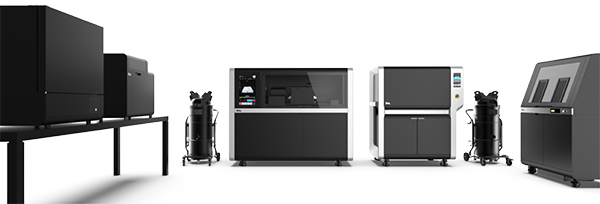
  • Expanding the Production SystemTM lineup, the new P-1 bridges benchtop process development and mass production for customers looking to scale to an industrial, high-volume additive manufacturing capacity
  • The P-1 offers Desktop Metal’s patent-pending Single Pass JettingTM (SPJ) technology in an inert environment with a smaller 1-liter form factor designed to print a full layer in less than 3 seconds

  • Full P-1 builds can be printed in less than one hour and process parameters transfer directly to the P-50, making the P-1 an ideal tool to develop materials and validate new applications without taking P-50 hardware offline from mass production jobs; the P-1 is also well-suited for running serial production of small, complex parts

  • Desktop Metal has begun shipments of the P-1, with Ford Motor Company as a key initial customer

  • The P-50, the flagship Production System printer, is designed to achieve speeds up to 100 times those of legacy powder bed fusion (PBF) additive manufacturing technologies(1), remains on schedule to begin volume commercial shipments in 2021, paving the way for the mass production of end-use parts, and unlocking throughput, repeatability, and part costs competitive with conventional mass production techniques

December 17, 2020, BOSTON, MA – ​Desktop Metal​ (NYSE: DM), a leader in mass production and turnkey additive manufacturing solutions, today announced the new P-1 printer has begun global shipments and joins the Production SystemTM lineup alongside the flagship P-50 printer. Designed to serve as a bridge from process development to full-scale mass production of end-use metal parts, the P-1 leverages the same patent-pending Single Pass JettingTM (SPJ) technology and core additive manufacturing benefits for companies and research institutions alike at the size and scale of serial production. The P-1 is now available for order and has already begun to ship to initial customers, including to the Ford Motor Company, which will receive its printer this month.

“We know industrial businesses around the world are eager to begin working with the Production System P-50 and benefit from the fastest, most cost-effective way to manufacture metal parts of all levels of complexity at-scale,” said Ric Fulop, CEO and co-founder of Desktop Metal. “Adding the P-1 to our Production System portfolio serves as a key enabler for these companies as they look to develop processes and materials on a smaller scale before ramping up to mass production volumes. Similarly, many businesses and research institutions are also interested in leveraging the economics and quality of SPJ technology for mid-volume serial production, making the P-1 an ideal fit and a great stepping-stone to broad adoption of Desktop Metal’s technology and flagship P-50 printer.”

The Ford Motor Company is among the first early adopters to purchase the new Production System P-1.

“Ford has been active in 3D printing since 1988 with acquisition of the third commercially available stereolithography (SLA) system; we are very excited to be early adopters of the P-1,” said Cynthia Flanigan, Director, Vehicle Research and Technology, Ford Research and Advanced Engineering. “We expect that this new system will serve as an important tool in the development of our future advanced process and alloy implementation, enabling our researchers to investigate additional production opportunities of metal binder jetting at Ford Motor Company. Our early collaboration with Desktop Metal highlighted the need for a lab scale system that is aligned with the functionality of the production scale system so we can further develop expertise around this process.”


A Shared SPJ Technology Architecture Enables Direct Process Transfers Between the P-1 and P-50

Created by leading inventors of binder jetting and single-pass inkjet technology, the Production System P-50 is an industrial manufacturing solution designed to achieve speeds up to 100 times those of legacy PBF additive manufacturing technologies(1), enabling production quantities of up to millions of parts per year at costs competitive with conventional mass production techniques.

The P-1 offers a new form factor to bridge the gap between benchtop process development and mass production, leveraging the same patent-pending SPJ technology and print carriage design as on the P-50 but with enhanced process flexibility. Also similar to the P-50, the P-1 features a state-of-the-art print bar with native 1200 dpi, advanced printhead technology that supports a wide variety of binders, and an inert processing environment to support both non-reactive and reactive materials, a key benefit for businesses and research institutions looking to experiment with a variety of materials. As a result, materials research and new application development conducted on the P-1 can be transferred directly onto the P-50 to scale to mass production, without the need to take this more industrial manufacturing solution offline for R&D activities, enabling efficient process development and new product introductions.

“For many businesses like Ford, the P-1 will serve as a learning lab for processes as they look to scale up to full production,” said Fulop. “Research institutions are also eager to adopt the Production System P-1 to experiment, validate materials, and test a variety of use cases for metal binder jetting with a smaller build box that offers all of the benefits of SPJ technology, including speed, quality, and reliability.

The P-1 Offers Cost-Effective, Serial Metal Parts Production for Small & Complex Parts

SPJ technology on the P-1 is designed to print each layer in less than three seconds, including powder deposition, powder compaction, anti-ballistics, binder deposition, and printhead cleaning. At this maximum build rate, the P-1 can achieve production throughputs 10 times higher than those of legacy PBF systems(1) and fast enough to complete a full build in less than one hour. The P-1’s open material platform and inert process environment allow customers to use low-cost, third-party metal injection molding powders across a variety of materials, making the P-1 suitable for cost-effective serial production of small and complex parts in addition to smaller scale process development activities. Powder reclaimed during the printing and depowdering process can be recycled for future use, driving further cost efficiencies and resulting in a more environmentally friendly manufacturing process. In addition, the tooling-free manufacturing process on the P-1 facilitates quick turnovers to new jobs along with the ability to print many complex geometries simultaneously with no print supports required. 

P-1 customers will also gain access to Desktop Metal’s Fabricate® manufacturing build preparation software, as well as to the Company’s newly-released Live Sinter™ application, which dynamically simulates the sintering process and automatically generates print-ready geometries that compensate for the shrinkage and distortion that take place during sintering, minimizing process trial and error while improving accuracy.

The flagship Production System printer, the P-50, remains on schedule to begin volume commercial shipments in 2021, paving the way for the mass production of end-use parts, and unlocking throughput, repeatability, and competitive part costs. For more information on the P-1, the P-50, and Production System technology, visit https://www.desktopmetal.com/products/production.

Please do read the original Press Release by Desktop Metal here.

Read More

Leveraging DfAM for Enhanced FDM Post-Printing Efficiencies with PostProcess Technologies

CONTENTS

I. Introduction to Design for Additive Manufacturing

II. FDM Background

III. DfAM Strategies

IV. Results

V. Conclusions

I. INTRODUCTION TO DESIGN FOR ADDITIVE MANUFACTURING

Additive manufacturing (AM) is a powerful technology that lends itself to producing organic geometries, and building parts in short timeframes. Additive technologies are capable of printing shapes that cannot be created by any other means. One of the most salient factors in successfully building these unique designs is the utilization of soluble support material.

As is well-known by anyone who has worked with additive technology, 3D-printed end use parts and prototypes do not come off of the printer “customer-ready.” Virtually every printed part, regardless of print technology, requires some sort of post-printing, whether that be support removal, resin removal, surface finish, or all the above.

As the additive production process has been classically categorized into three separate silos; design, build/print, and post-print, the final step is all too often an afterthought. Rather than considering the additive process a linear, sequential one, PostProcess Technologies embraces the ideology that efficiencies and end part results can be dramatically improved when all of the steps are conceptualized as interdependent.This integrated approach is an advanced ideology that will be necessary to scale additive’s impact, and eventually usher in Industry 4.0.

This paper will identify the ways in which designing for additive manufacturing (DfAM) can affect efficiencies, cost, and support material usage in Fused Deposition Modeling (FDM) printing. Print orientation, support settings within the slicing software, and part design are all aspects which can be leveraged to streamline additive workflows, and facilitate faster, more cost-effective post-printing.

It should be noted that while some of these DfAM for FDM techniques can be applied to other print technologies, this is not the case universally (e.g. self-supporting angles are also useful in DfAM for stereolithography (SLA), but not selective laser sintering (SLS) or PolyJet).

As a rule of thumb, DfAM will have a greater effect in circumstances where there is a higher level of design freedom. While DfAM will have a minimal impact on rapid prototyping or tooling applications (situations with the lowest allowance for design freedom) manufacturing aides and end-use production parts allow for more unique designs, thus making DfAM more significant. The more design principles that are considered upfront, the less time must be later allotted to redesign, or the removal of unnecessary support structures later in the process.


II. FDM BACKGROUND

To comprehend the DfAM techniques that will streamline an FDM workflow, it is vital to comprehend the advantages and limitations of the print technology, and why it is one of the most popular 3D printing technologies available today. The process starts with a thermoplastic filament wound in spools. This filament could be ABS, Polycarbonate, or Ultem™*, for example (see the image below for a complete list of Stratasys thermoplastic materials available for use with the brand’s FDM printers). Strength requirements, the temperature that the part will be exposed to, its performance expectations, and the sort of chemical resistance that it requires are all factors that may impact material selection.

The filament is extruded through a heater block, then a nozzle, and computer-controlled motion is used to deposit the melted thermoplastic. As the deposited plastic cools, the z-stage build platform is lowered to create the 3D part. While this layer-by-layer deposition process is ideal for parts with low heights, FDM printers can face challenges printing complex geometries with tall and thin walls. Virtually anywhere there is an overhang on an FDM part, support material will likely be required to prevent build failure, leading to high support material usage. Consequently, FDM processes involve tedious support removal steps, which traditionally involve dissolving support material by using detergents or breaking the supports away manually, depending on the support material used.

As reported by the PostProcess Technologies’ 2020 Annual Additive Post-Printing Trends Report, material extrusion printing methods (e.g. FFF, FDM, MEM) are utilized by 71% of additive manufacturing users, making them the most popular print technology. The top challenge of material extrusion technology was found to be the length of time to finish parts, while the runner-up answer was damaged parts, both issues that DfAM can help mitigate. That being said, additional research has found that 23% of the average part cost for polymer 3D printing is attributed to the post-printing step alone (Source: 2019 Wohler’s Report). Finally, keeping support material to a minimum is ideal in lowering the build time required for a part, the material cost of a part, as well as the time and resources which must be allocated to the post-printing step.

III. DFAM STRATEGIES

Orientation
Depending on the geometry of your part, orientation may play a paramount role in DfAM. Usually a sole aspect like part strength, support structures, print speed, or surface quality must be prioritized to determine the best orientation of the part. Strength is most often the driving factor for orientations, though priorities may change depending on print materials used, or time restraints. Considerations regarding part orientation should be explored during the design phase to proactively ensure minimal support material requirements, as well as printing and post-printing speeds.

Figure 1 shows a L-bracket printed on its end and Figure 2 shows the same L-bracket printed flat on its side. Utilizing GrabCAD Print software, the green represents the model material of the part and the orange represents the support material required to print the part in that orientation. This change in build orientation accounted for a 58% reduction in build time, and a 91% reduction in support material usage, equating to cost, material, and time savings.

FIGURE 1: End Orientation
FIGURE 2: Side Orientation

Part Design
Knowing the advantages (and limitations) of a print technology is vital in designing the most efficient, structurally-sound part possible.

Self-Supporting Angles

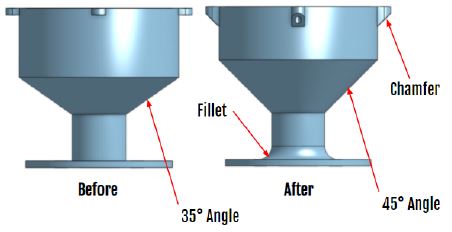
FDM is one of the only technologies that leverages self-supporting angles. Typically, as long as there is at least a 45° overhang to the build platform, support materials will not be needed. This strategy can also come into play by implementing chamfers and/or fillets, for example see Figures 3 and 4. Also by using the SMART support settings within GrabCAD Print or Insight on Stratasys printers, the software will automatically utilize self-supporting angles when developing support structures, which will help to reduce the amount of support material needed in comparison to other support styles. The actual self supporting angle value will vary based on the printed model material and the slice height that the printer is set at. For example, on a Stratasys Fortus 450mc, loaded with ASA material and printing at a slice height of 0.010” / 0.254 mm will have a self-supporting angle of 43°, whereas Nylon 12CF is 50°.

FIGURE 3: Overhanging Geometry Example
FIGURE 4: Self Supporting Geometry Example

Implementing Strategic Holes
Designing vertical, non-critical holes as diamond or teardrop-shaped instead of round will reduce the amount of support material required (see bearing block image below). Critical diameter holes should be printed in the XY plane if possible. If the vertical holes require tighter accuracy, they may be drilled out in a post-printing step. When using an automated support removal system it is best practice to reduce the amount of blind holes and cavities. Rather, when possible implement through holes and open cavities, allowing the support removal detergent to flow through those areas more freely, and remove support material faster.

Material Usage
In certain circumstances, utilizing model material as support material can decrease build time, specifically by reducing wait time caused by the printer switching between model and support material. However, this time reduction is only realized if the entire layer’s support material can be changed to model. Whenever you slice a part in GrabCAD Print or generate support material in Insight, the software automatically generates support material and will interface directly with the model material, giving it a good foundation to build model material on. When changing the support material to model material, you will want to leave the three or four support material interface layers, or the layers below where the model material starts, as support material. Otherwise, the model support may end up fused to the finished part,
subsequently causing damage to your overall part.


Surface Finishing
Orientation can also impact the surface finish of a part. Exterior contour toolpaths will result in a better surface finish than exposed raster toolpaths, as rasters are more likely to cause air gaps, which can prove difficult to remove. While flat orientations may print faster, particularly with FDM, horizontal orientations with exterior contour paths will take significantly less time to post-print (see example in image below). FDM parts will also always have a “seam”, which is the start/stop point of each build layer. Utilizing the slicing software to determine where a seam should be placed can help reduce surface finishing time on specific part areas.

IV. RESULTS

As a result of implementing the various DfAM techniques that this white paper covers, small-scale FDM parts were able to achieve significant build time and material savings, thus streamlining the entire additive process. Below is a step-by-step explanation of what part features were changed in the CAD modeling software, and what settings were changed in GrabCAD Print to achieve the desired results, reducing build time and support material usage.

Sensor Bracket Part

Part features added:
– Interior and exterior fillets added to increase the strength of the bracket.

GrabCAD Print Settings:
– Orientate the part with the “L” profile in the XY plane of the build platform (see picture below).
Reduce the amount of support material required by selecting “Do not grow supports” in the Support Settings.

Bearing Block Part

Part features added:
– Modified the mounting holes from round to diamond shaped, making the geometry self-supporting.

GrabCAD Print Settings:
-Orientate the part with the diameter of the large vertical hole in the XY plane of the build platform (see picture below).
– To place the layer seams on the back of the part (a noncritical surface) select the surfaces where you don’t want the seam placed (critical surfaces), and select “Avoid Seams” in the Model Setting section. This will help to reduce surface finishing time on critical surfaces. This feature only works for parasolid part files that are imported into GrabCAD Print, and will not work with STL files.

Coupling Part

Part features added:
Changed the angle of the coupling from 35° to 45° to make the geometry self-supporting.
Added a fillet between the base of the part and the vertical cylinder to help strengthen that area.
Added a chamber under the top tabs to make the geometry self-supporting.

GrabCAD Print Settings:
Orientate the part with the round base in the XY plane, as shown below.

Before and After Printing Results
The below picture illustrates the reduction in build time and support material used by making the small design changes and printer setting changes listed above.

Sensor Bracket

Bearing Block

Coupling

Before
Build Time: 2:51
Model: 3.008
Support: 0.658

After
Build Time: 2:25
Model: 3.107
Support: 0.321

Before
Build Time: 5:05
Model: 7.544
Support: 0.742

After
Build Time: 4:18
Model: 7.709
Support: 0.219

Before
Build Time: 4:16
Model: 3.694
Support: 2.092

After
Build Time: 2:47
Model: 3.833
Support: 0.312

Difference
Build Time: -26 minutes
Model: +.01 in³ / +0.25 mm³
Support: -0.34 in³ / -8.64 mm³

Difference
Build Time: -47 minutes
Model: +0.17 in³ / +4.32 mm³
Support: -0.52 in³ / 13.21 mm³

Difference
Build Time: -89 minutes
Model: +0.14 in³ / +3.56 mm³
Support: -1.78 in³ / 45.21 mm³

V. Conclusions

  • To utilize additive to the best of its ability, it is essential to recognize that the design, build, and post-print steps are heavily integrated. It is most strategic to consider support removal and surface finishing during the design phase.
  • When designing an FDM part for optimized post-printing, factoring in material selection, part orientation, self-supporting angles, contour toolpaths, as well as chamfers and fillets as needed, can contribute to time, cost, and materials savings.
  • Automated post-printing solutions from PostProcess Technologies can further enable efficiencies within additive workflows, and cut down on overall time and money spent on the AM process. The proprietary Volumetric Velocity Dispersion technology for soluble support and Suspended Rotational Force for surface finishing both leverage various chemical and mechanical energy sources for optimal post-printing for FDM.

POSTPROCESS TECHNOLOGIES INC.
2495 Main Street, Suite 615
Buffalo NY 14214, USA
+1.866.430.5354


POSTPROCESS TECHNOLOGIES INTERNATIONAL
Les Aqueducs B3, 535 Route des Lucioles
06560 Sophia Antipolis, France
+33 (0)4 22 32 68 13

Please visit PostProcess Technologies for more info and white papers.

Read More
uv inkjet 3d printer

Mimaki Illuminates 3D Printing Market with New Compact Full-Colour UV Inkjet 3D Printer

  • The new Mimaki 3DUJ-2207 3D Inkjet Printer boasts full-colour high definition production in a sleek, compact design, with over 10 million colours

  • The machine delivers an affordable, scalable solution to drive accessibility to 3D printing and deliver its cutting-edge technologies to a host of new customers

Mimaki Europe, in conjunction with Mimaki USA, a leading manufacturer of inkjet printers and cutting systems, today announces the launch of its new compact, full-colour 3DUJ-2207 UV Inkjet 3D Printer. Previously the first to bring over 10 million colours to the 3D printing market with its larger-scale industrial counterpart, the 3DUJ-553, Mimaki now combines the same impressive colour range and renowned build quality in a compact, affordable solution. With this latest offering, Mimaki aims to extend the reach and accessibility of its cutting-edge 3D printing technologies to an entirely new segment of customers.

The innovative 3D printing solution represents a huge step forward for detailing and post-processing, with the unique combination of its full-colour capabilities and water-soluble support materials enabling super-fine details to be printed in vibrant colour, and then beautifully preserved without the substantial breakage risks usually associated with manual cleaning, painting and finishing. With additional features such as Mimaki’s trademark clear resin, which can be utilised alone or mixed with colours to achieve varying levels of transparency, the new 3DUJ-2207 3D printer presents a robust, advanced 3D printing solution with an affordable price tag – all within a machine sufficiently compact to fit in an office elevator.

“Here at Mimaki, we do not stop at developing disruptive technologies – we make it our business to look even further beyond this, continually striving to find ways in which we can then accelerate the adoption of these technologies and drive the wider industry forward,” comments Danna Drion, Senior Marketing Manager at Mimaki Europe. “Our new 3DUJ-2207 3D Printer is a prime example of this. We had already raised the bar in 3D printing by delivering the world’s first 3D printer with over 10 million colours – but now, with the introduction of our new 3DUJ-2207 3D Printer, we are bringing these 10 million colours to a host of new customers, which in turn means new applications and an even quicker uptake of 3D printing technologies as a whole.”

Set to be commercially available worldwide from January 2021, the 3DUJ-2207 has been designed with functionality at its core, with the compact design and reduced 203 x 203 x 76mm build space just two of many key features which demonstrate its unique versatility and make it ideally suited for office environments. The 3D printer’s quiet performance and optional deodoriser minimise some of the primary disruptions usually associated with 3D printing technologies, ensuring maximum workability in busy workspaces.

Utilising UV-curing inkjet technology, the expansive high-definition colour expression made possible with the Mimaki 3DUJ-2207 3D Printer is around twice that of powder bed manufacturing methods. This provides new possibilities for prototyping and enables the accurate reproduction of subtle colour differences which are critical for many industrial design applications such as medical and architectural modelling. Additional applications include small-scale models for design offices and educational settings, as well as collectible figures.

Drion concludes, “By combining our technological expertise with a wealth of industry experience and market insight, we have been able to create an innovative, inspired solution that merges functionality, affordability and design in a way that really will be game-changing for a lot of creators. This launch will deliver a world of new possibilities to designers and product developers, for many of whom the idea of high-definition full-colour 3D printing might previously have been out of reach, and that is something we are extremely proud of.”

The Mimaki 3DUJ-2207 3D Printer will be exhibited online at Formnext Connect and as part of Mimaki’s latest virtual event, the Mimaki 3D Experience, from 10th November to 16th December. Follow Mimaki’s social media channels for more information.

Please do read the original press release here or visit MimakiEurope.com to learn more.

Read More